
EURUSD
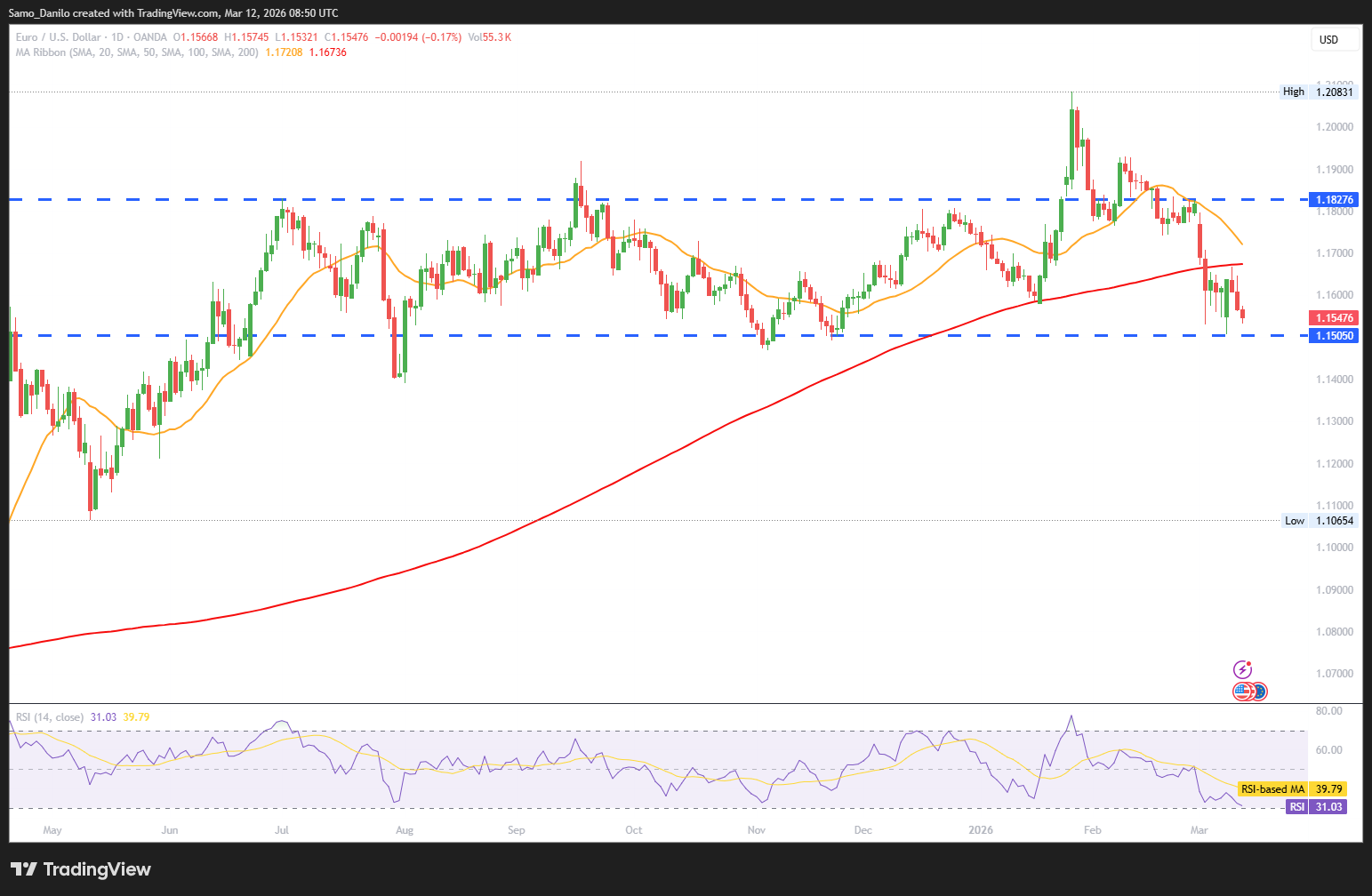
- EUR/USD Price: The EUR/USD has declined for a third consecutive session, slipping below the 1.1550 level. The move reflects a stronger US Dollar and cautious sentiment as investors reassess monetary policy expectations and geopolitical risks.
- ECB's Schnabel: Isabel Schnabel of the European Central Bank stated that the institution’s upcoming quarterly forecasts will partially account for the economic consequences of the conflict involving Iran. The war’s impact on energy prices and inflation is a key concern for policymakers.
- ECB's Kažimír: Peter Kažimír, a member of the European Central Bank Governing Council, indicated that an interest rate hike could arrive sooner than previously expected. He noted that the central bank might act if the conflict leads to a rise in inflation expectations.
- ECB rate: Financial markets have increased expectations for tighter ECB policy following hawkish remarks from officials. According to London Stock Exchange Group data, traders now anticipate the European Central Bank could begin raising interest rates as early as June.
- Euro rates: Analysts Michiel Tukker and Benjamin Schroeder from ING Group highlight that euro interest rates remain highly sensitive to movements in energy markets. Markets are still pricing potential ECB rate hikes extending into 2026 as energy-driven inflation risks persist.
| SMA (20) | Slightly Rising |  |
|
| RSI (14) | Falling |  | |
| MACD (12, 26, 9) | Falling | | |
Closing statement: EUR/USD remains under pressure as investors weigh a stronger US Dollar against shifting expectations for ECB policy. Energy prices and geopolitical developments will continue to play a crucial role in shaping the euro’s outlook in the coming months.
GBPUSD
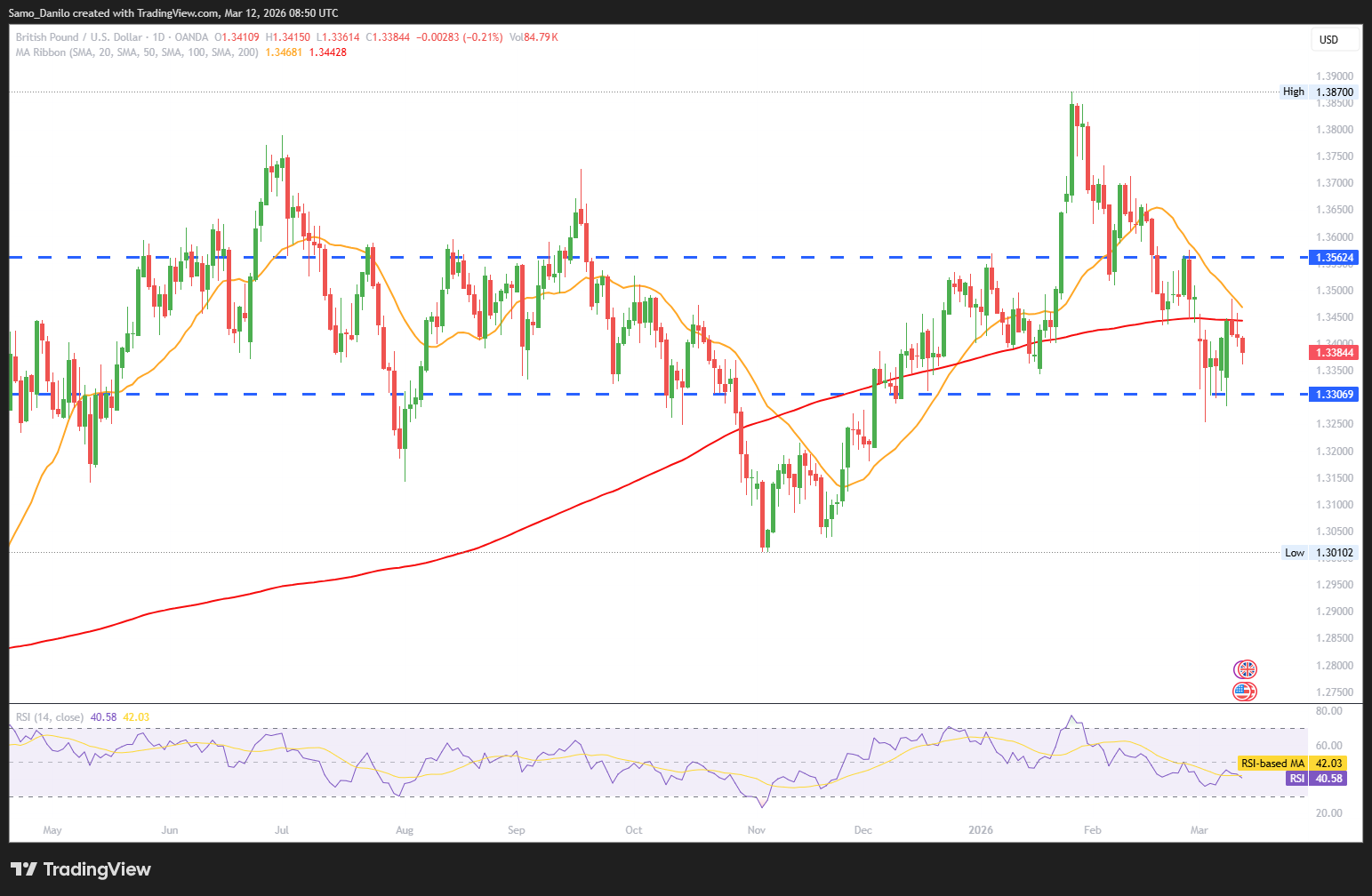
- GBP/USD Price: The GBP/USD has declined for the third consecutive session, slipping to around the 1.3370 level during European trading. The move reflects renewed strength in the US Dollar as investors seek safer assets amid rising geopolitical tensions.
- US Dollar: With no clear signs of de-escalation in the Middle East conflict, global markets have shifted toward risk-off positioning. The resulting flight to safety has strengthened the US Dollar, placing downward pressure on the Pound.
- Middle East: The Islamic Revolutionary Guard Corps reported a joint military operation with Hezbollah targeting sites in Israel, Jordan, and Saudi Arabia. The widening scope of the conflict has heightened global risk aversion and increased volatility in currency markets.
- BoE rate: Market expectations for the Bank of England have changed significantly. Earlier forecasts of three interest rate cuts have now been replaced with growing expectations that the central bank may deliver a rate hike before the end of the year.
- Events ahead: Investors are awaiting remarks from Andrew Bailey, Governor of the Bank of England, later today. Attention will then shift to the United Kingdom’s monthly Gross Domestic Product release and the Personal Consumption Expenditures Price Index from the Federal Reserve on Friday.
| SMA (20) | Falling | | |
| RSI (14) | Slightly Falling | |
|
| MACD (12, 26, 9) | Falling | | |
Closing statement: GBP/USD remains under pressure as geopolitical risks boost demand for the US Dollar. However, shifting expectations for Bank of England policy and upcoming economic data could influence the pair’s short-term direction.
XAUUSD
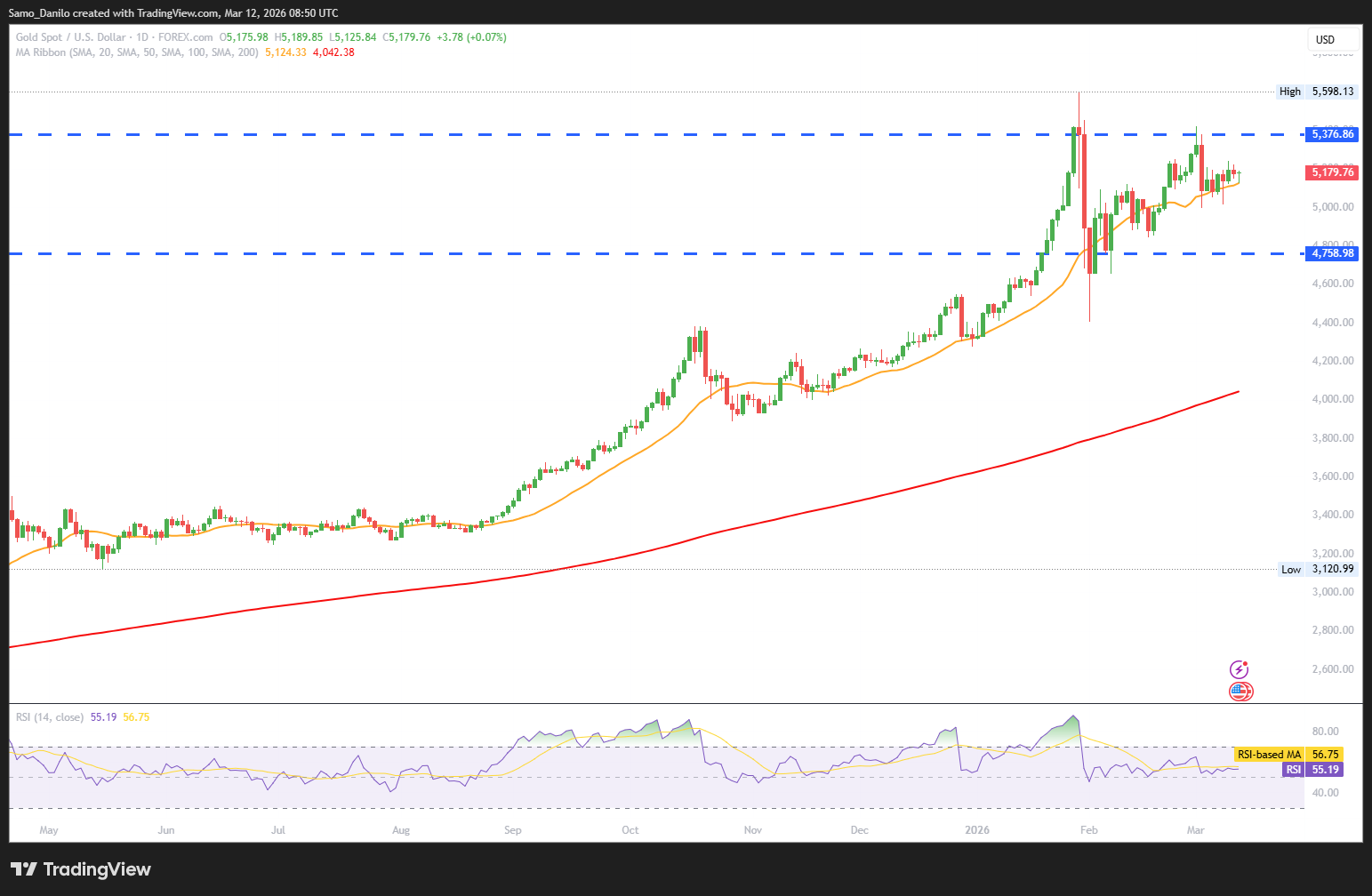
- XAU/USD Price: The XAU/USD recovered most of its earlier losses and is trading slightly above the $5,165 level during the early European session. The rebound in gold reflects persistent safe-haven demand amid geopolitical tensions and cautious investor sentiment.
- US Inflation: Recent data from the Bureau of Labor Statistics showed the Consumer Price Index for February remained stable. Headline inflation held at 2.4% year-on-year, while core inflation remained at 2.5%. On a monthly basis, CPI rose 0.3% and core CPI eased slightly to 0.2%, suggesting moderate but persistent inflation pressures.
- IMF outlook: Kristalina Georgieva, head of the International Monetary Fund, warned that a sustained 10% increase in Crude Oil prices over a year could raise global inflation by roughly 40 basis points. This highlights the inflationary risks stemming from current energy market volatility.
- Trade data: Investors are also awaiting the release of International Trade Balance figures for January. Economists expect that rebounding imports may widen the United States trade deficit in early 2026.
- Data ahead: Later today, markets will closely watch the weekly Initial Jobless Claims report for additional signals on labor market conditions. Attention will then shift to Friday’s Personal Consumption Expenditures Price Index, a key measure used by the Federal Reserve to guide monetary policy decisions.
| SMA (20) | Rising | | |
| RSI (14) | Slightly Rising | |
|
| MACD (12, 26, 9) | Slightly Rising | |
Closing statement: Gold remains supported by safe-haven demand and stable inflation data, but upcoming US economic releases, particularly jobless claims and the PCE inflation report, will likely determine the next directional move in the precious metal.
CRUDE OIL
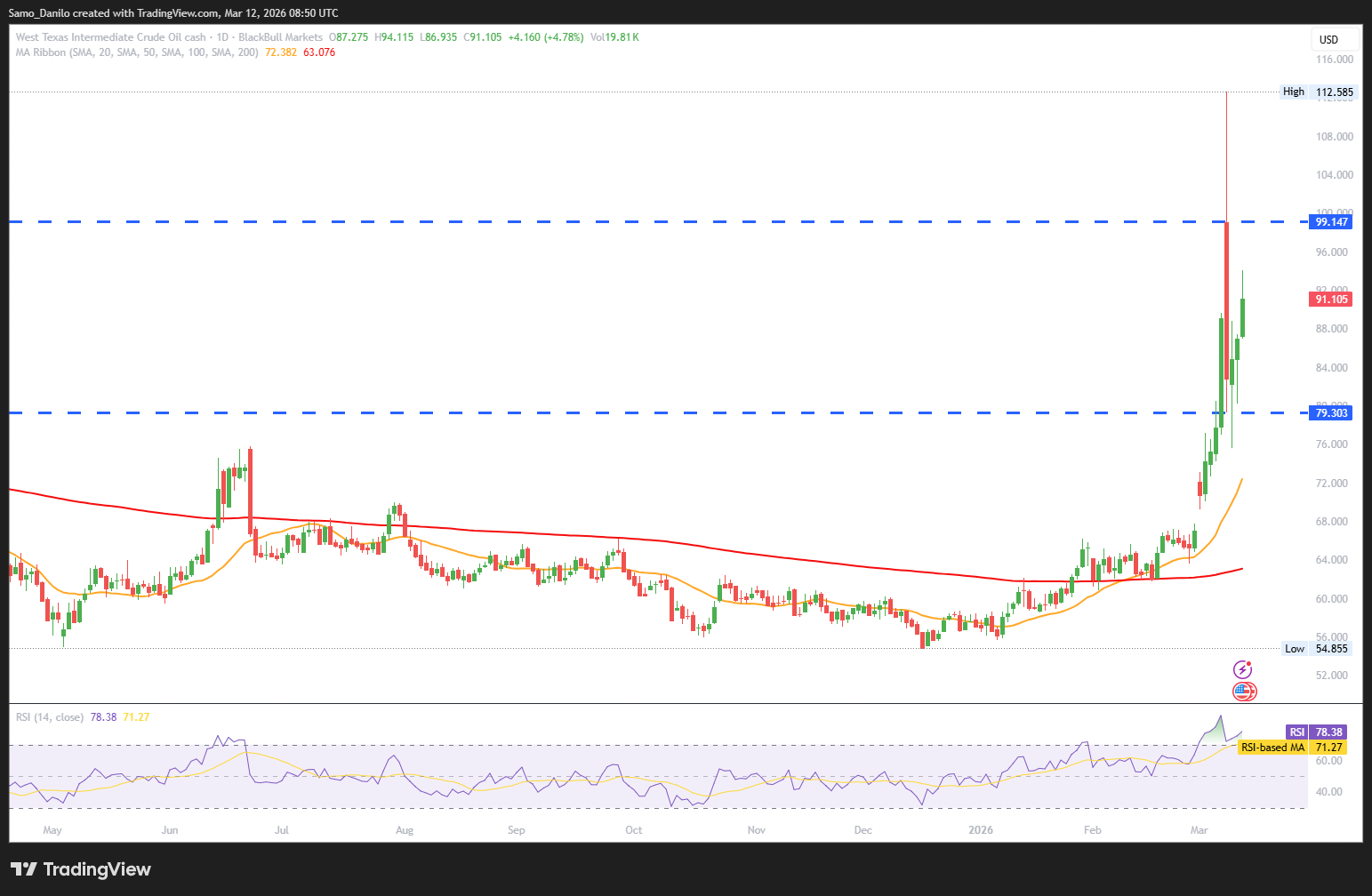
- Crude Oil Price: The Crude Oil market continued its upward momentum, with prices climbing toward the $91 per barrel region. The gains reflect persistent concerns over supply disruptions and escalating geopolitical risks in the Middle East.
- Tanker attacks: Reports that two oil tankers were attacked in the northern Persian Gulf near Iraq and Kuwait triggered a renewed surge in oil prices. The incidents intensified fears about the safety of energy shipments through one of the world’s most important oil transit regions.
- Strategic reserve: The International Energy Agency announced a record release of 400 million barrels from global strategic reserves. However, the move had limited impact on market sentiment as traders had largely anticipated the decision and details about the pace and allocation of the release remain unclear.
- SPR release: Donald Trump ordered the release of 172 million barrels from the Strategic Petroleum Reserve. The measure aims to mitigate the supply shock caused by disruptions in the Strait of Hormuz, where Iran has reportedly begun targeting vessels.
- Saudi Aramco: Saudi Aramco has asked Asian buyers to submit crude loading plans for April from both its main Gulf export facilities and alternative terminals on the Red Sea. The move suggests preparations for potential disruptions to shipments through the Strait of Hormuz.
| SMA (20) | Rising | | |
| RSI (14) | Rising | | |
| MACD (12, 26, 9) | Rising | | |
Closing statement: Crude oil markets remain highly sensitive to geopolitical developments in the Persian Gulf. Despite large planned releases from strategic reserves, tanker attacks and ongoing threats to shipping routes continue to support elevated oil prices.
DAX
- DAX Price: The DAX opened with a significant gap down and is currently trading around 23,520 points. The initial decline reflects investor caution following geopolitical tensions and volatility in global energy markets.
- ECB signals: Joachim Nagel, head of the Deutsche Bundesbank and a member of the European Central Bank Governing Council, stated that the ECB is prepared to respond if rising energy prices linked to the Iran conflict push Eurozone inflation persistently higher.
- Government debt: Governments across the Eurozone are considering measures to shield households and small businesses from rising energy costs. Such support programs could result in larger fiscal deficits and higher sovereign debt issuance in the region.
- BMW news: BMW expects earnings to fall this year as tariffs, rising raw-material costs and efforts to stabilize its operations in China weigh on profitability. Like many European automakers, the company faces intense competition in the Chinese market.
- DHL plans: DHL Express, part of Deutsche Post DHL Group, confirmed it will maintain its long-term investment strategy in the Middle East despite the conflict involving Iran. The company sees the region as strategically important for future logistics growth.
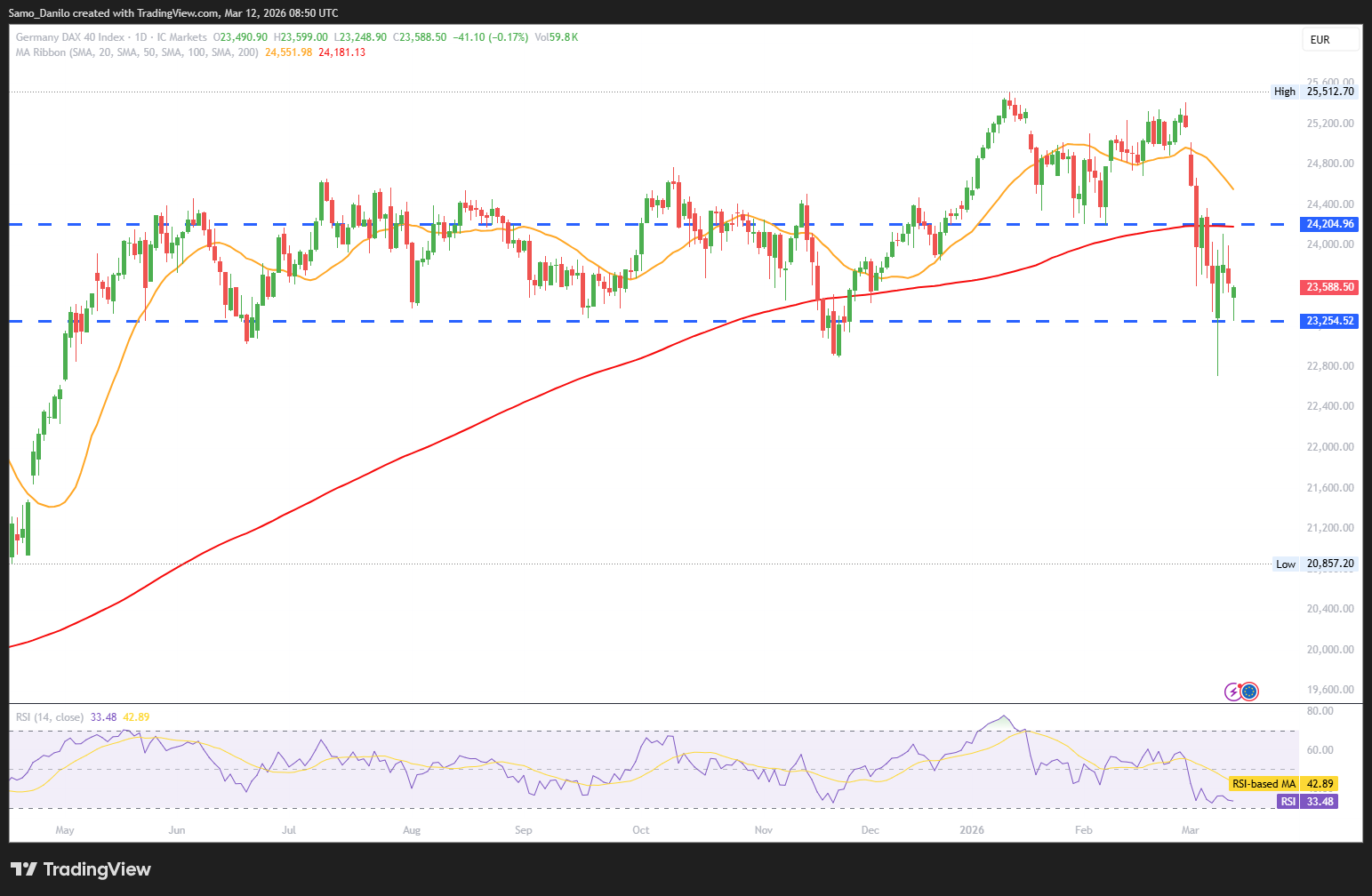
| SMA (20) | Falling | | |
| RSI (14) | Falling | | |
| MACD (12, 26, 9) | Falling | | |
Closing statement: The DAX remains under pressure from geopolitical risks and rising energy costs, while corporate outlooks and potential fiscal responses in the Eurozone will likely shape investor sentiment in the near term.