
EURUSD
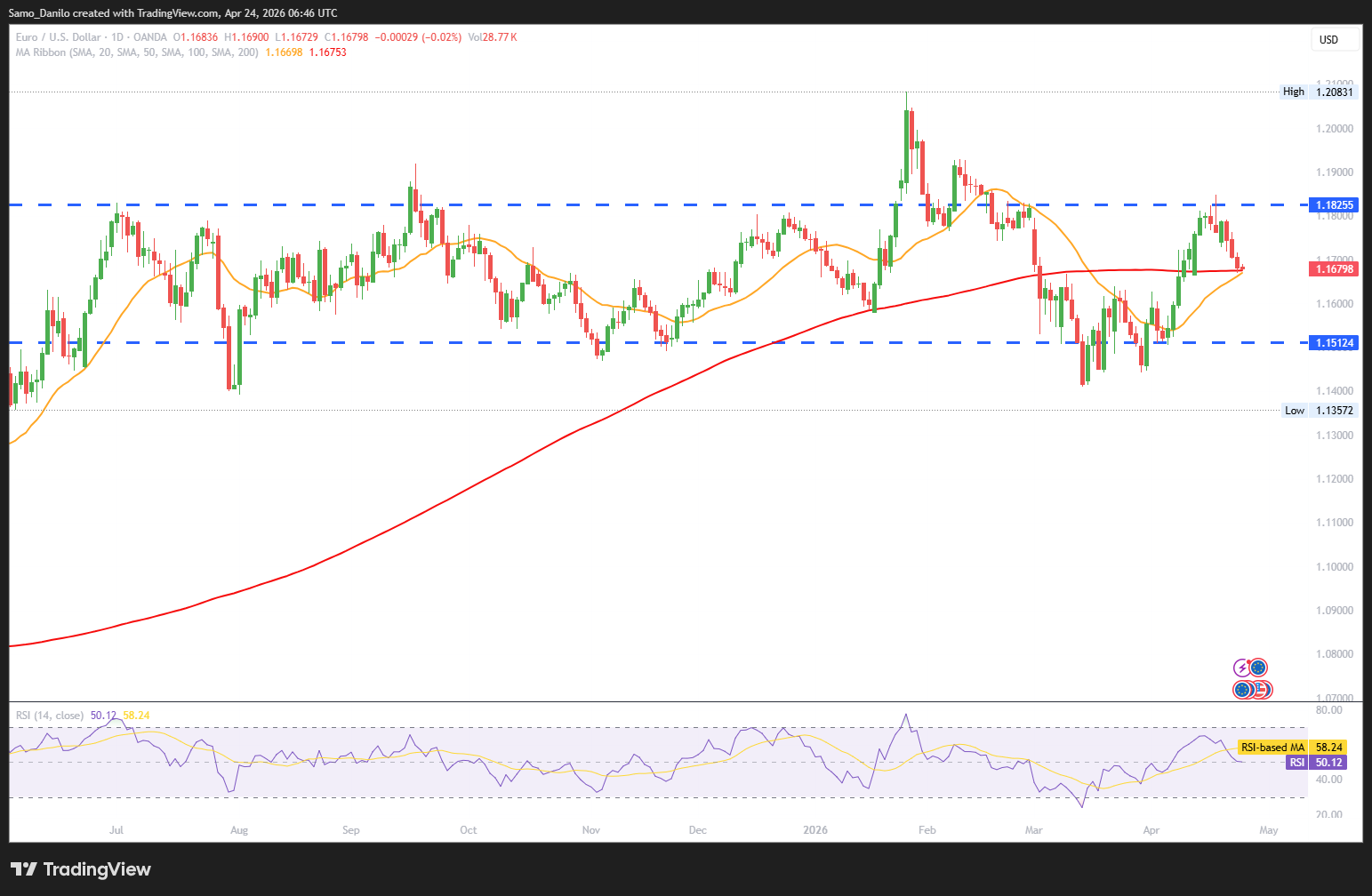
- EUR/USD Price: EUR/USD is trading cautiously below the 1.1700 mark, reflecting a lack of bullish conviction. This suggests that downside pressure remains, with the pair struggling to regain upward momentum.
- US-Iran: Reports from Bloomberg indicate that the United States intercepted Iranian oil tankers attempting to bypass the blockade. Ongoing tensions with Iran continue to disrupt global energy flows and increase uncertainty.
- Labor market: US Initial Jobless Claims rose slightly to 215K, signaling continued strength in the labor market. This resilience supports the US Dollar by reinforcing confidence in the underlying economy.
- Eurozone PMI: Eurozone Composite PMI unexpectedly dropped to 48.6, falling below the expansion threshold of 50. This indicates contraction in private sector activity and reflects weakening economic conditions.
- Energy shock: Rising energy costs linked to the Iran conflict are pressuring consumer demand and the services sector. This has led to the fastest contraction in Eurozone private sector activity since late 2024.
| SMA (20) | Slightly Rising |  |
| RSI (14) | Slightly Falling |  |
| MACD (12, 26, 9) | Slightly Rising | |
Closing statement: EUR/USD is under pressure as weak Eurozone data and rising energy costs contrast with resilient US economic performance. The near-term outlook is bearish, with downside risks prevailing unless Eurozone fundamentals improve or USD strength fades.
GBPUSD
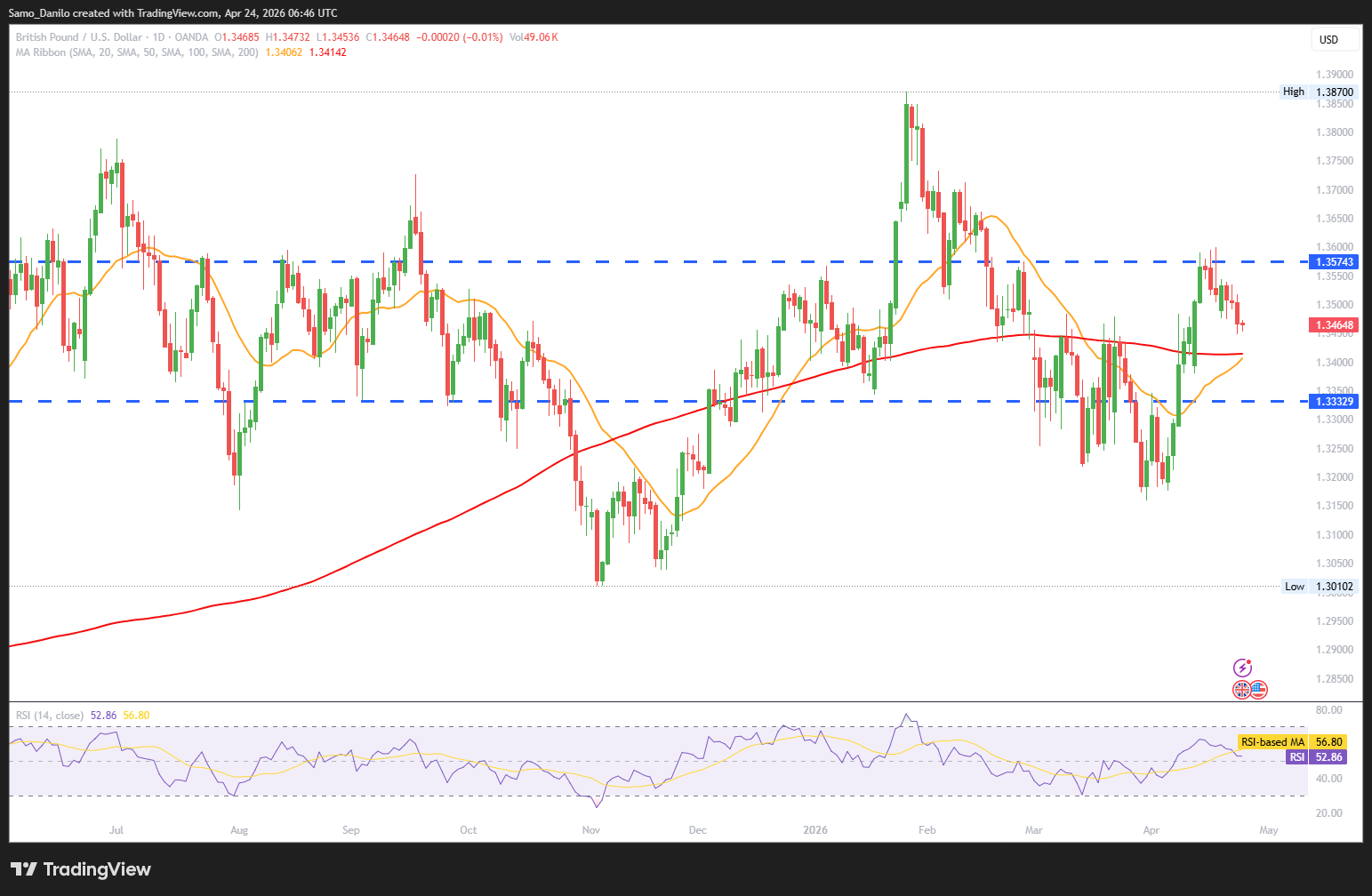
- GBP/USD Price: GBP/USD is trading around 1.3465, just above a two-week low, indicating a consolidation phase within a broader downward trend. This suggests that selling pressure persists, although momentum has temporarily stabilized.
- Ceasefire extended: Donald Trump indicated that Israel and Lebanon will extend their ceasefire. This development could support global risk sentiment by reducing regional tensions.
- Retail sales: Data from the Office for National Statistics showed retail sales rebounding by 0.7% MoM in March. This improvement highlights resilience in consumer spending following the previous month’s decline.
- BoE policy: Markets are increasing bets on further tightening by the Bank of England, with around 60 bps of hikes priced in by end-2026. The stronger-than-expected PMI data has reinforced expectations of a possible rate hike as early as June.
- US PMI: US PMI data from S&P Global exceeded expectations, with both manufacturing and services sectors indicating expansion. This reinforces the strength of the US economy and provides support for the USD.
| SMA (20) | Slightly Rising | |
| RSI (14) | Slightly Rising | |
| MACD (12, 26, 9) | Slightly Rising | |
Closing statement: GBP/USD remains under pressure despite supportive UK data, as strong US economic performance and prior bearish momentum dominate. The near-term outlook is neutral to slightly bearish, with direction dependent on relative policy expectations and macro data.
XAUUSD
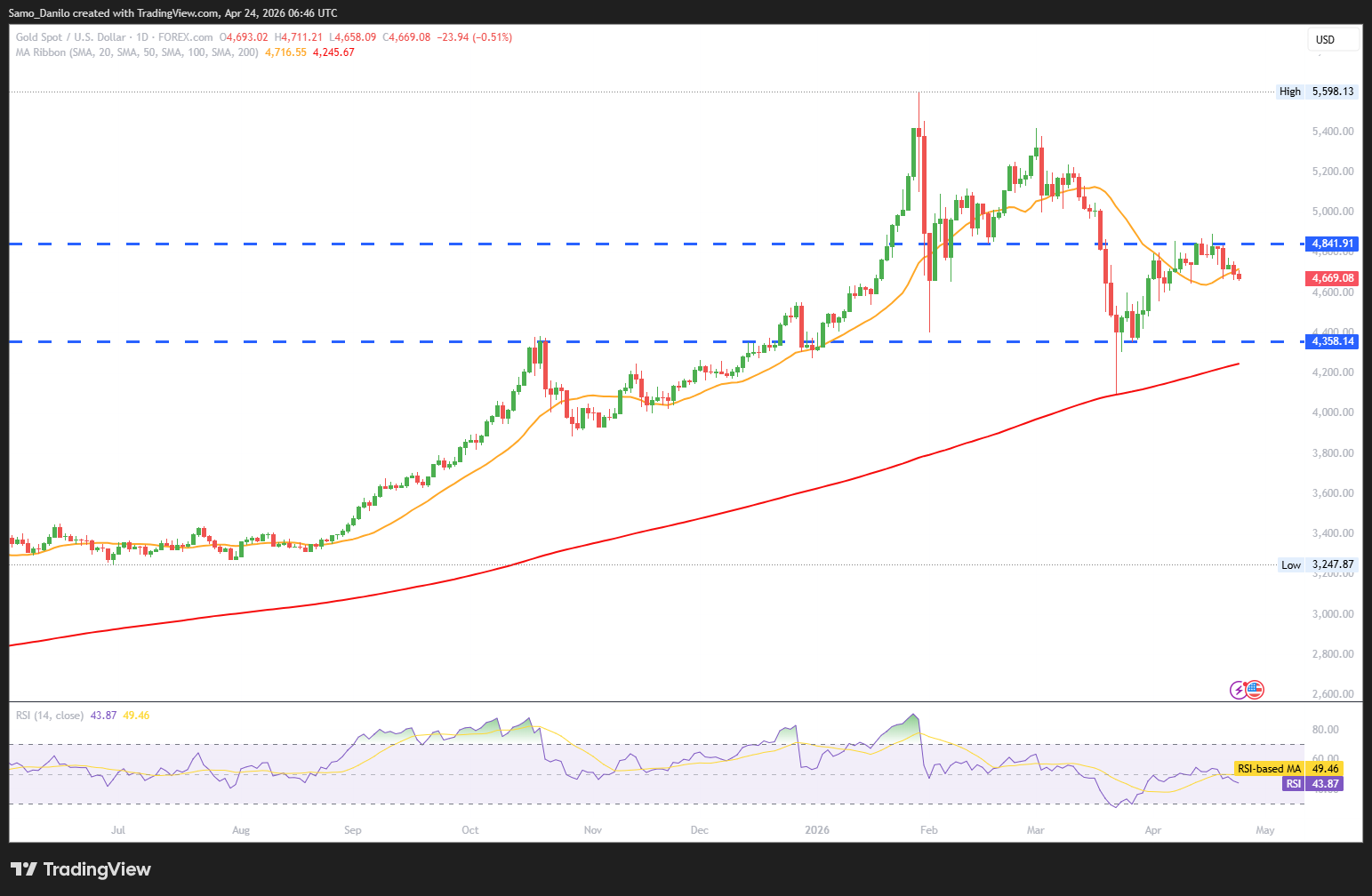
- XAU/USD Price: Gold has fallen to around $4,670, marking a two-week low and putting it on track for its first weekly loss in five weeks. This reflects sustained selling pressure and a shift in short-term sentiment.
- US blockade: Iran's Foreign Minister, Abbas Araghchi described the US blockade as an act of war, highlighting ongoing friction between the United States and Iran. These tensions continue to create an underlying layer of uncertainty in global markets.
- Fed rate: Market pricing suggests only one 25-basis-point cut by the Federal Reserve in 2026. This more restrictive policy outlook reduces support for non-yielding assets like gold.
- Intel earnings: Intel reported strong earnings, driving a sharp after-hours rally. Positive corporate performance can shift investor preference toward risk assets and away from safe havens like gold.
- Consumer sentiment: Markets are awaiting the revised University of Michigan Consumer Sentiment Index. This data will provide insights into consumer confidence and could influence expectations for economic growth and policy.
| SMA (20) | Slightly Falling | |
| RSI (14) | Slightly Falling | |
| MACD (12, 26, 9) | Slightly Falling | |
Closing statement: Gold is under pressure as stronger risk sentiment and reduced expectations for rate cuts outweigh geopolitical concerns. The near-term outlook is bearish, with further downside possible unless macro or risk conditions shift in favor of safe-haven demand.
CRUDE OIL
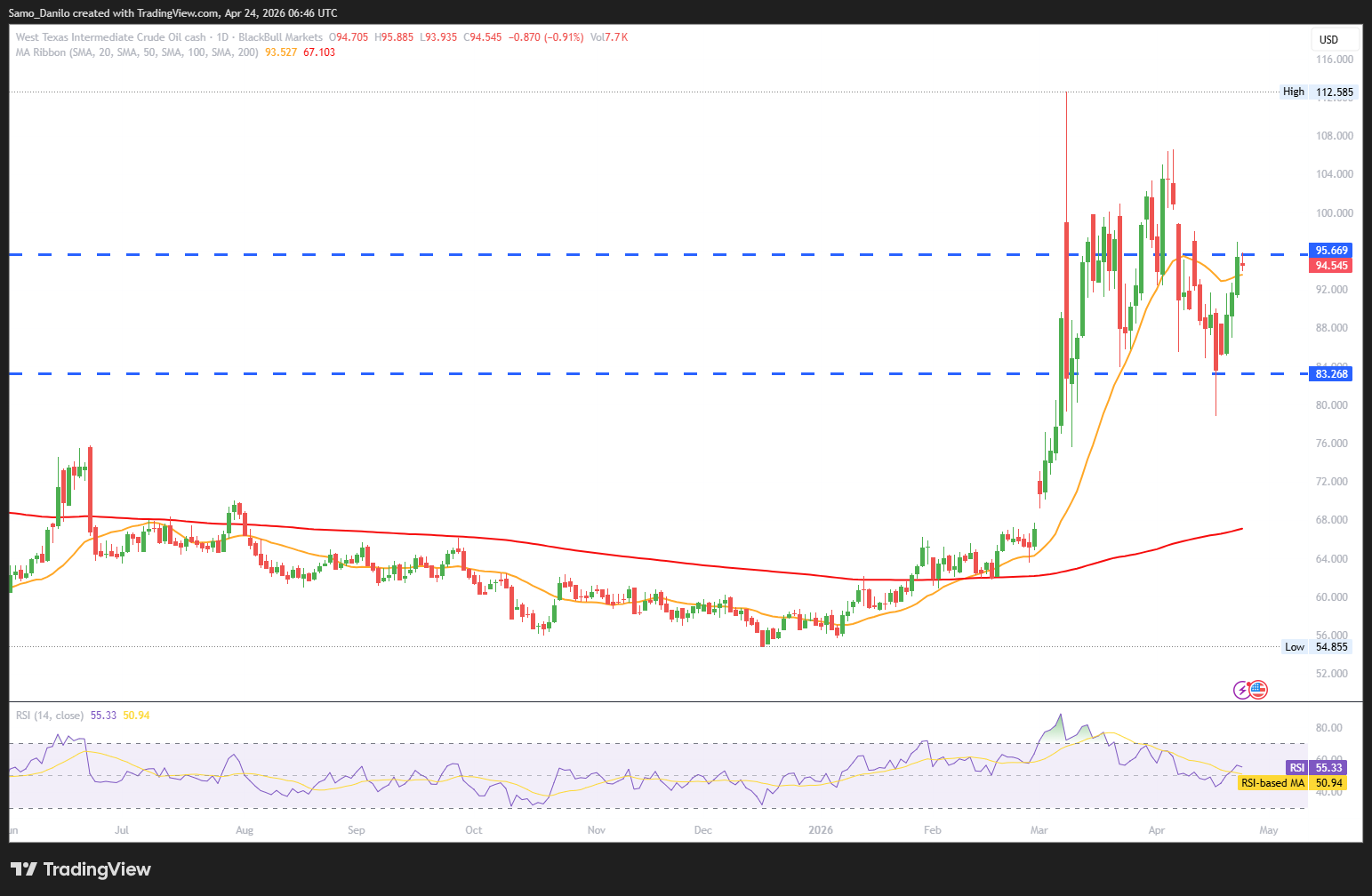
- Crude Oil Price: WTI is trading around $95, consolidating just below a two-week high near $97. This indicates strong bullish positioning, with prices holding elevated levels after a significant rally.
- Jones Act: The American Maritime Partnership welcomed the extension of the Jones Act waiver by the United States administration. This move supports domestic energy logistics and could help ease some supply chain constraints.
- Russia news: Russian President Vladimir Putin highlighted the growing importance of Northern Sea routes amid global disruptions. This reflects Russia’s strategy to adapt to shifting energy trade dynamics and secure alternative export pathways.
- Indian refiner: Reliance Industries, the biggest oil refiner in India, is expected to report a drop in profits for its fourth quarter to March, driven by the oil price surge caused by the war in the Middle East.
- Russian supply: The Kremlin, via spokesman Dmitry Peskov, confirmed that Russia will continue exporting oil steadily. This approach aims to stabilize global markets amid disruptions caused by the Middle East conflict.
| SMA (20) | Rising | | |
| RSI (14) | Rising | | |
| MACD (12, 26, 9) | Slightly Rising | |
Closing statement: Crude oil remains strongly supported near recent highs, with supply disruptions offset by steady Russian exports and policy adjustments. The near-term outlook is bullish, with consolidation likely before any further upward move depending on geopolitical developments.
DAX
- DAX 40 Price: The DAX is trading about 0.5% higher near 24,200 points, indicating a short-term recovery. However, the upside appears limited as broader macroeconomic concerns continue to weigh on sentiment.
- German PMI: Germany’s flash Composite PMI dropped to 48.3, well below expectations and back into contraction territory. This signals a significant slowdown in business activity across both manufacturing and services.
- Growth outlook: The Federal Ministry for Economic Affairs and Climate Action has cut its 2026 growth forecast by half. The downgrade reflects the negative impact of the ongoing energy shock linked to Middle East tensions.
- Automotive sector: Volkswagen Group and Mercedes-Benz Group signaled caution regarding demand in China, with expectations of a prolonged slowdown. This raises concerns for one of Germany’s most important export sectors.
- Technology sector: SAP delivered solid results, offering some reassurance to investors despite being one of the weakest performers this year. This highlights uneven performance across sectors within the index.
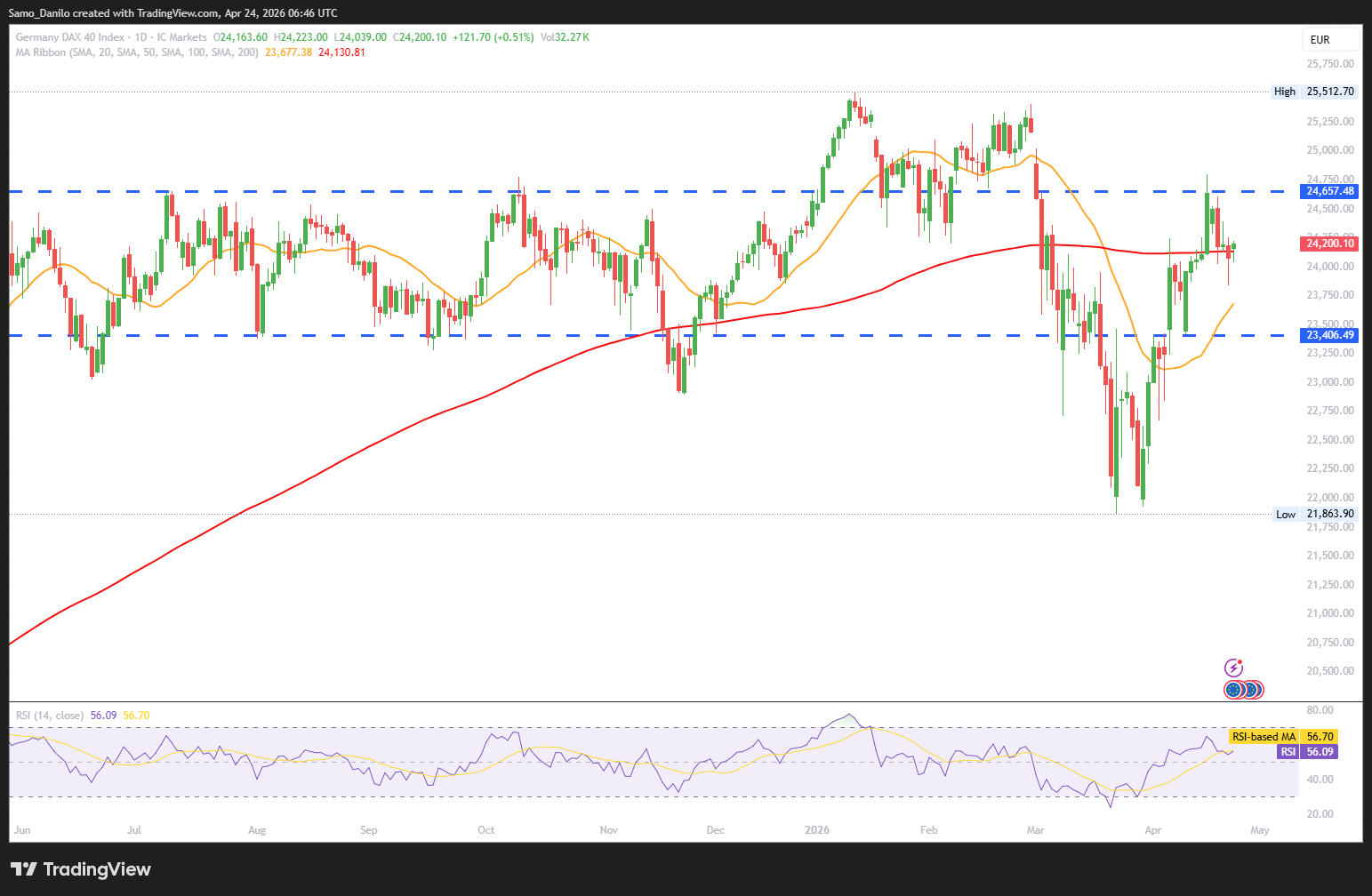
| SMA (20) | Rising | | |
| RSI (14) | Slightly Rising | |
|
| MACD (12, 26, 9) | Slightly Rising | |
Closing statement: The DAX is showing short-term resilience, but weakening economic data, downgraded growth forecasts, and sector-specific headwinds limit upside potential. The near-term outlook remains cautious, with downside risks tied to macroeconomic deterioration.